Echoplex Healthcare Solutions Achieves BBB Accreditation, Strengthening Trust with Healthcare Clinics
Kitchener-Waterloo, Ontario – March 3rd, 2025 – Echoplex Healthcare Solutions Inc. is proud to announce its accreditation by the Better Business Bureau (BBB), reinforcing its commitment to integrity, transparency, and high-quality service within the healthcare industry. This achievement serves as a testament to Echoplex’s dedication to fostering trust between medical clinics and IT service providers by adhering to recognized ethical business practices.
As a BBB Accredited Business, Echoplex Healthcare Solutions meets and upholds the BBB’s rigorous standards, ensuring reliability, accountability, and superior customer service. This accreditation demonstrates the company’s commitment to ethical conduct, a key factor for healthcare organizations seeking dependable and professional IT solutions.
“Our accreditation with the BBB is a significant milestone in our mission to support medical clinics with secure, efficient, and compliant IT solutions, By meeting the BBB’s standards, we reaffirm our dedication to fostering long-term relationships with healthcare providers, ensuring they receive the highest level of trust and service.”
Echoplex Healthcare Solutions specializes in providing tailored IT services for medical clinics, including electronic medical record (EMR) support, cybersecurity, network management, and proactive IT maintenance. With the BBB accreditation, the company further solidifies its reputation as a trusted partner in the healthcare sector.
For more information about Echoplex Healthcare Solutions and its commitment to ethical business practices, please visit www.echoplex.ca or contact us at 226-473-1255.

The Critical Role of Disk Encryption Keys and Backup Testing in EMR Management
In the digital age of healthcare, electronic medical records (EMRs) are the cornerstone of modern medical practice. They contain sensitive patient information and are vital to delivering quality care. Protecting this data is not just a regulatory requirement but also a fundamental responsibility. Two crucial aspects of safeguarding EMR systems are managing disk encryption keys and regularly testing backups.
Why Disk Encryption Keys Matter
Disk encryption ensures that the data on your storage devices is unreadable without proper authorization. It provides a strong defense against unauthorized access, especially in cases of theft or device loss. However, encryption is only as reliable as the management of the encryption keys.
Risks of Losing Encryption Keys:
- Permanent Data Loss: Without the encryption key, even authorized users cannot access the data.
- Service Interruptions: Losing access to critical data can disrupt clinic operations and delay patient care.
- Compliance Violations: Healthcare organizations are legally obligated to safeguard patient data. Failing to do so can result in fines and reputational damage.
Best Practices for Managing Encryption Keys:
- Secure Storage: Store encryption keys in a secure location, such as a hardware security module (HSM) or encrypted key management system.
- Redundancy: Maintain backup copies of keys in secure, separate locations.
- Access Control: Limit access to encryption keys to authorized personnel only.
The Importance of Backup Testing
Backups are the safety net for your EMR system. They ensure that in the event of data loss—whether due to hardware failure, cyberattacks, or human error—you can restore operations quickly. However, backups are only effective if they work when you need them.
Why Testing Backups is Essential:
- Data Integrity: Regular testing verifies that backups are complete and free of corruption.
- Recovery Speed: Testing helps identify bottlenecks in the restoration process, ensuring you can recover quickly during an emergency.
- Compliance: Regulations such as PIPEDA in Canada and HIPAA in the U.S. mandate that healthcare organizations have reliable data recovery plans.
Backup Testing Best Practices:
- Schedule Regular Tests: Test your backups monthly or quarterly to ensure they remain functional.
- Simulate Real-World Scenarios: Run tests that mimic actual data loss situations to evaluate the recovery process under pressure.
- Verify All Critical Data: Ensure that patient records, appointment schedules, and other essential files are included in the backup.
The Intersection of Encryption and Backups
It’s vital to remember that encrypted data must be backed up with the encryption keys readily accessible for restoration. If the backup is encrypted and the keys are lost, the backup becomes useless. Integrating encryption key management into your backup strategy is a critical step to ensuring data availability.
Conclusion
Managing disk encryption keys and regularly testing backups are non-negotiable elements of EMR system maintenance. These practices protect sensitive patient data, ensure compliance with regulations, and safeguard the operational integrity of your clinic. By prioritizing these measures, you not only enhance the security of your EMR system but also build trust with your patients, who rely on you to keep their personal health information safe.
Make these practices a cornerstone of your data management strategy—because in healthcare, protecting data means protecting lives.
Chime : Transform your clinic by delivering the right person, to the right place, at the right time.
In today’s fast-paced healthcare environment, clinics constantly seek ways to enhance efficiency while maintaining high standards of patient care. CHIME, a clinic management system, offers a compelling solution for streamlining workflows in Family Health Teams or multi-physician clinics. After exploring its features, here’s a detailed review of how CHIME can improve day-to-day operations through its strategic use of waiting room screens, exam room door check-in screens, and a robust central dashboard.
Key Features and Benefits
1. Self Check-In Kiosks:
One of the standout features of CHIME is its self check-in kiosks. By allowing patients to check in for appointments without interacting with staff, CHIME minimizes congestion at the front desk, especially during peak hours. The kiosks can even provide pre-visit instructions and direct patients to staff if further assistance is needed, reducing bottlenecks and common delays.
2. Waiting Room Displays:
Mounted screens in waiting areas display estimated wait times for patients, helping to manage expectations and reducing frustration. The displays can also automatically direct patients to the appropriate exam room when their turn comes. Privacy settings can be adjusted to display patient names in a way that respects confidentiality while keeping them informed. For clinics looking to reduce wait times and enhance patient flow, this is a game-changer.
3. Room Tablets:
CHIME integrates wall-mounted tablets outside exam rooms, giving both patients and staff a way to interact with the system. These tablets display key information about patient status and allow clinicians to see who’s waiting or which room is available. The system intelligently assigns patients to rooms, minimizing the time staff spends on manual room assignments.
4. Central Dashboard:
For clinic staff, the central dashboard serves as the nerve center, offering real-time updates on appointments, clinician availability, room status, and patient flow. This feature is accessible on any device and can be customized based on the clinic’s needs. It fosters better coordination between staff and clinicians, streamlining tasks such as patient queue management, room assignments, and clinician scheduling.
Operational Efficiency and ROI
The overall goal of CHIME is to deliver the right person to the right place at the right time, dramatically reducing inefficiencies. By automating labor-intensive tasks such as patient check-ins, room assignments, and notifications, CHIME helps clinics to operate with fewer staff members while still maintaining high throughput. For example, clinics that adopt CHIME have seen a reduction in staff needs by two full-time equivalents and an increase in patient capacity by up to three full-time physicians.
Beyond efficiency, CHIME also delivers an impressive return on investment. According to data, CHIME can increase clinic income by up to $100 per square foot annually and help clinics accommodate 40-60% more patients per day, all while reducing operating costs per appointment by 50%.
Final Thoughts
For Family Health Teams and multi-physician clinics, CHIME offers a comprehensive solution to some of the most common operational challenges. Its user-friendly design, combined with powerful automation capabilities, not only improves clinic workflows but also enhances patient satisfaction. By reducing administrative burdens, CHIME allows healthcare providers to focus more on delivering quality care to their patients.
In short, for clinics looking to optimize their operations and streamline patient management, CHIME is a smart investment with tangible benefits. For more information, visit CHIME’s website at www.chimeclinic.com.
Phelix AI offers an ideal solution to streamline fax and document management
For clinics like Family Health Teams (FHTs) and other multi-doctor practices, managing administrative tasks across a large number of patients and providers can be overwhelming. Phelix AI offers an ideal solution to streamline fax and document management, helping clinics enhance efficiency and patient care. Here’s how Phelix AI can benefit Family Health Teams and multi-doctor clinics:
1. Automated Fax Management for High-Volume Practices
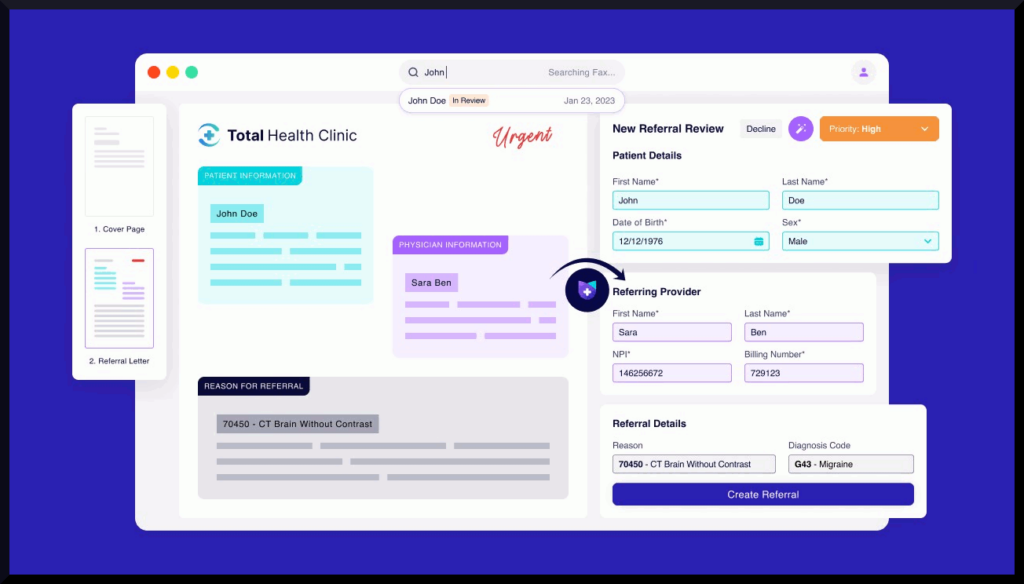
In multi-doctor clinics, the volume of incoming faxes, such as referrals, test results, and specialist reports, is significantly higher. Manually sorting and processing these documents is not only time-consuming but also prone to errors. Phelix AI’s fax automation feature allows Family Health Teams to handle this volume effortlessly. Using AI and machine learning, the system categorizes, extracts, and organizes essential data from incoming faxes, ensuring that each document is accurately routed to the appropriate doctor or department. This can be particularly useful for managing shared patient records and collaborative care plans, as faxes can be processed and made available to multiple providers quickly.
2. Centralized Workflow for Multi-Provider Coordination
Family Health Teams often require a high degree of coordination between doctors, nurses, and allied healthcare professionals. Phelix AI helps create a centralized communication and document management system by integrating with the clinic’s existing fax services and EMR systems. This streamlines administrative workflows, enabling team members to access patient information in real time without delays, ensuring better coordination in patient care.
With Phelix AI, documents like referrals and specialist reports can be automatically triaged and incorporated into a shared EMR, ensuring all providers working with a patient have access to the most up-to-date information. This is especially beneficial for team-based models where multiple doctors may be involved in a patient’s treatment.
3. Improved Efficiency in Handling Patient Referrals
Managing patient referrals in a multi-doctor setting can be complex. Phelix AI simplifies the process by automating the intake and processing of referral documents. Its AI tools extract critical data from faxes, such as patient demographics, referring physician details, and the nature of the referral, before categorizing and routing the information to the appropriate provider within the clinic.
This automation reduces the time spent on manual data entry, minimizing the risk of lost or misplaced referral documents. It ensures that referrals are processed faster, improving patient wait times and overall satisfaction.
4. Tailored to Multi-Doctor and Multi-Site Clinics
For Family Health Teams that operate across multiple locations, managing the flow of patient information can be even more challenging. Phelix AI’s flexible integration allows clinics to scale its use across different sites while maintaining consistent workflows. All faxes, whether they are received at the main clinic or a satellite location, are processed and categorized centrally, ensuring that doctors and support staff have access to the same patient data regardless of their location.
5. Enhancing Team Efficiency with Customizable Workflows
With Phelix AI, Family Health Teams can tailor workflows based on their specific needs. For example, the system can be customized to route certain types of documents to specific providers or departments, ensuring that specialists or specific care teams receive relevant information automatically. This level of automation is key for clinics managing large volumes of patients across various disciplines, allowing staff to focus on patient care instead of paperwork.
6. Time and Cost Efficiency
One of the most significant benefits Phelix AI brings to Family Health Teams is the time and cost savings it delivers. By automating up to 75% of the tasks that typically require manual labor—such as sorting, processing, and filing incoming faxes—clinics can reduce the time staff spend on administrative work. This increased efficiency frees up resources, allowing administrative teams to focus on other important functions, such as patient coordination or billing.
Additionally, automating repetitive tasks helps reduce operational costs. Clinics no longer need to allocate as many staff members to handle these processes, and the risk of human error is minimized. This reduction in errors leads to fewer delays, more accurate billing, and overall smoother operations, which can significantly improve clinic profitability and staff morale.
7. Security and Compliance
In healthcare settings, data security and patient privacy are paramount, especially in multi-doctor clinics where sensitive information is shared across different providers. Phelix AI ensures full compliance with healthcare regulations such as HIPAA and PIPEDA, protecting patient information throughout the faxing and document management process. This helps Family Health Teams maintain the highest standards of confidentiality while improving operational efficiency.
Conclusion
For multi-doctor clinics and Family Health Teams, Phelix AI offers a comprehensive solution to simplify and automate fax management, streamline patient referrals, and enhance overall workflow efficiency. By reducing administrative burdens, improving coordination across care teams, and providing significant time and cost savings, clinics can allocate more time to patient care, improving both provider satisfaction and patient outcomes.
Implementing Phelix AI in your clinic allows for more efficient use of resources, quicker response times for patient care, and smoother coordination across multiple providers, making it an essential tool for any Family Health Team. For more details, visit Phelix AI.
Why Your Clinic Should Have Contracted RMM Services and Onsite Visits
In the evolving landscape of healthcare technology, managing IT infrastructure has become increasingly crucial. Clinics and healthcare facilities rely heavily on their systems for patient data management, scheduling, and maintaining records. This dependence means even minor disruptions can lead to significant operational and financial setbacks. For healthcare providers in Ontario, partnering with Echoplex Healthcare Solutions offers a streamlined, efficient, and secure way to manage these IT challenges through Remote Monitoring and Management (RMM) services, coupled with periodic onsite visits.
The Benefits of Remote Monitoring and Management (RMM) Services
RMM services involve proactive monitoring, troubleshooting, and maintaining your IT systems remotely. For medical practices relying on their Electronic Medical Record (EMR) systems and other healthcare software, this ensures that their technology infrastructure remains up-to-date, secure, and fully operational. Here’s why you should consider Echoplex Healthcare Solutions for RMM services:
- 24/7 System Monitoring Healthcare practices require their systems to be available at all times. RMM services from Echoplex provide constant monitoring of your servers, network, and workstations, identifying potential issues before they escalate into critical failures. Whether it’s preventing a system crash or detecting unusual activity, the peace of mind that comes with 24/7 oversight is invaluable to any medical practice.
- Proactive Problem Solving Unlike traditional IT support, which is reactive in nature, RMM services are proactive. Echoplex can detect vulnerabilities, performance bottlenecks, or hardware failures and address them before they impact your clinic’s operations. This means fewer disruptions to your workday, better patient care, and the ability to prevent costly outages and repairs.
- Enhanced Security The healthcare sector is particularly vulnerable to cyber threats. A breach not only compromises sensitive patient data but can also damage your clinic’s reputation. Echoplex’s RMM services include real-time threat detection and immediate responses to any suspicious activity. Regular updates and patch management are also handled remotely, ensuring your systems are always protected against emerging threats and comply with regulations like PHIPA and HIPAA.
- Improved Performance Over time, IT systems can slow down, causing delays in accessing patient records or scheduling. With RMM services, Echoplex Healthcare Solutions ensures your servers and network infrastructure are optimized for speed and performance. This leads to smoother clinic operations, allowing staff to focus more on patient care than on waiting for slow systems.
- Cost-Effective IT Management RMM services offer a cost-effective solution for healthcare clinics. By identifying and addressing potential issues early, clinics can avoid costly emergency repairs or data recovery. Additionally, remote support means that many issues can be resolved without the need for an onsite visit, reducing downtime and the need for additional service costs.
The Value of Onsite Visits
While RMM services offer comprehensive remote oversight, onsite visits remain an essential component of complete IT management. Onsite visits ensure that your physical infrastructure remains in top shape and give clinic staff a chance to address any concerns directly with IT professionals.
- Physical System Checks and Maintenance Some issues require hands-on attention. During onsite visits, Echoplex technicians can perform routine hardware inspections, upgrade outdated equipment, and troubleshoot problems that are more effectively handled in person. These visits provide the opportunity to catch any hardware-related issues that might be missed during remote monitoring.
- Personalized Support Onsite visits allow Echoplex to tailor solutions specific to your clinic’s needs. In-person consultations provide an opportunity to discuss system optimization, workflow improvements, and any unique challenges your clinic may face. This face-to-face interaction helps build trust and ensures that solutions are custom-tailored for your clinic’s operations.
- Building Stronger IT Relationships Regular onsite visits foster a more collaborative relationship between your clinic and your IT provider. It allows staff to feel more comfortable asking questions or raising concerns that they may not otherwise address. Building this rapport ensures your IT infrastructure evolves alongside your clinic’s changing needs.
- Comprehensive Audits and Assessments Onsite visits allow for comprehensive reviews of your clinic’s entire IT setup, including network architecture, data backups, and overall security practices. This is essential in ensuring compliance with data privacy laws and improving operational efficiency. Regular audits keep systems up-to-date and ensure there are no hidden vulnerabilities in your network.
Why Echoplex Healthcare Solutions?
Echoplex Healthcare Solutions has carved out a reputation as a trusted provider of healthcare IT services, particularly in the Ontario region, serving clinics across Kitchener, Waterloo, Cambridge, and surrounding areas. Here’s why contracting Echoplex is a smart choice for medical practices:
- Industry-Specific Expertise
Echoplex specializes in the healthcare sector and understands the unique needs of clinics, from managing EMR systems to maintaining compliance with healthcare regulations. Their team brings a wealth of experience working with clinics of all sizes, ensuring a tailored approach to IT management. - Proactive, Preventative IT Solutions
With a focus on preventing problems before they arise, Echoplex offers more than just reactive support. Their RMM services and onsite visits combine to create a robust, well-rounded approach to IT management, ensuring your clinic’s systems are always running smoothly and securely. - Cost-Efficient and Scalable
Whether you’re a small clinic or a large medical center, Echoplex offers scalable service packages that meet your budget and operational requirements. Their proactive model ensures that your clinic avoids the high costs of emergency repairs and system downtime.
In today’s healthcare environment, keeping your IT infrastructure running smoothly and securely is non-negotiable. By contracting Echoplex Healthcare Solutions for RMM services and regular onsite visits, your clinic benefits from proactive IT management, enhanced security, improved performance, and personalized support.
For more information, contact 226-473-1255 to learn more about how Echoplex Healthcare Solutions can support your clinic’s IT needs.